If you’ve ever stood in a machining shop, watching a milling machine carve a precise pocket into a block of aluminum or a boring tool dial in a perfect inner cylinder for a hydraulic component, you’ve probably wondered why those two cutting tools look so different—even if their jobs seem related. As someone who’s spent 12 years as an end mill supplier, working side by side with machinists to solve problems, I can tell you this isn’t just a cosmetic difference; it’s a matter of material science, geometry, and exactly what each tool is designed to do. Too often, I’ve gotten calls from new machinists or small workshop owners, confused about when to reach for an end mill vs. a boring bar, and how mixing them up can turn a $5 part into scrap. Let’s break this down, not just with textbook definitions, but with the hands-on insights that come from working on real jobs every day. End Mills
First, let’s anchor both terms in what they actually do, because that’s the root of every difference. Milling (with an end mill) is a machining process that removes material from a workpiece by engaging the tool with the surface as the tool moves in multiple directions: linear (up, down, left, right), curved, or at angles. End mills—our core product line—are multipurpose cutting tools built to do this. Boring, by contrast, is a process focused exclusively on enlarging a pre-existing hole, usually one that was drilled, cast, or punched. A boring tool (most commonly a boring bar, though some specialty inserts fit other holders) works only on inner cylindrical surfaces, to get that hole to the exact diameter, roundness, and surface finish a part needs. The core job difference sounds simple, but it ripples through every design choice, from the number of cutting edges to the tool’s overall shape.
Let’s start with the most visible difference: geometry, and how that ties to what each tool is allowed to cut. End mills have cutting edges on both their end face and their peripheral (side) surface. That dual cutting capability is what makes them so versatile. A standard 2-flute end mill, for example, uses its end face to plunge straight down into a solid workpiece to make a new pocket, then switches to its side flutes to contour the edges of that pocket. A 4-flute end mill is stiffer, so it can take heavier cuts on flat surfaces without chattering. But here’s a critical limit: most general-purpose end mills (and even specialty ones like ball nose or corner radius) aren’t designed to reach deep inside a hole and cut a larger inner diameter. Their end face is flat, and if you tried to use it to enlarge a hole, the center of the end—where the tool’s core is thickest—would act like a plug, not a cutter. You’d end up with a lopsided, undersized hole, or worse, break the tool entirely.
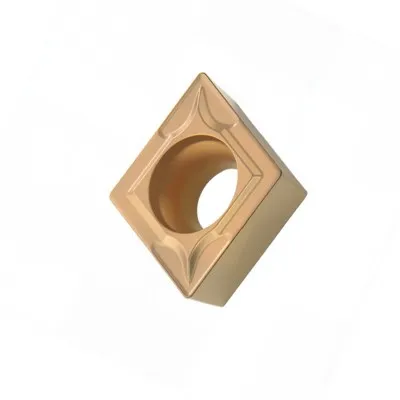
Boring tools, though, are built for exactly that deep inner cut. A standard boring bar has a single cutting insert (we supply compatible inserts for most major bar brands, if your shop uses specific holders) mounted on the end of a rigid shaft. The insert has only one or two cutting edges, located on the very tip of the bar, designed to engage only the inner cylindrical wall of a hole. Unlike end mills, they don’t cut with their end face at all—they move radially outward from the center of the existing hole, increasing its diameter incrementally. That single-point design is intentional: a boring bar is long and slender, so it can reach into a deep hole without interfering with the walls, and its narrow cutting point lets it make tiny, precise adjustments to diameter (often within thousandths of an inch) that end mills can’t match. I learned this the hard way early in my supply career, when a small aerospace shop customer ordered 10 ½-inch end mills to bore landing gear hinge holes. By the time they called me panicking, they’d broken three end mills and their holes were off by 0.015 inches. I walked them through the difference in geometry, sent them a set of 1-inch boring inserts that fit their existing holders, and they were back on track in a day. That moment stuck with me because it’s a perfect example of how geometry isn’t just a design choice—it’s a production saver.
Next, let’s talk about rigidity and deflection, because that’s where the practical, real-world impact hits machinists. End mills, especially for general milling, have a large core diameter— that’s the solid center part of the tool that holds the flutes. The core is thick because end mills have to handle downward forces from plunging, side forces from contouring, and lateral forces from cutting flat surfaces. A thick core reduces deflection, so the tool doesn’t wiggle or vibrate (chatter) during cuts. Chatter isn’t just a quality issue; it wears tools out faster, can damage workpieces, and slows production down. For end mills, core diameter correlates with flute count: more flutes mean a thicker core for stiffness, which is why 4-flute end mills work better for heavy roughing, while 2-flute end mills are better for plunging thin materials where a thicker core would cause too much friction.
Boring tools are the opposite when it comes to rigidity. The boring bar’s core has to be as thin as possible, because it has to fit inside the existing hole, but it also has to be stiff enough to resist deflection when the insert cuts into the inner wall. That’s why most quality boring bars are made from high-tensile steel or carbide—carbide bars are stiffer than steel, so they deflect less, making them ideal for deep holes. But here’s the catch: even the most rigid boring bar will deflect if the hole is too deep relative to the bar’s length. That’s why machinists use micro-boring heads or offset boring bars for extra-deep holes, to keep deflection within tolerance. End mills don’t face that same limit because they’re designed to work on external surfaces or open cavities, not confined inner holes. I recently had a customer in the oil and gas industry, making components for pump shafts, who was trying to bore a 12-inch deep hole in a 16-inch diameter steel block with a 1-inch carbide end mill. They were ending up with a taper of 0.02 inches at the bottom of the hole—all from deflection. Once they swapped to a 1-inch carbide boring bar, they got a perfect, straight hole within 0.001 inches of their spec. That’s the tangible difference rigidity makes for each tool’s use case.
Cutting action is another key distinction that’s easy to overlook. End mills perform both peripheral milling and face milling, which means they can cut in three axes: X, Y, and Z. Peripheral milling uses the side flutes for side cuts, face milling uses the end face for plunging or facing across a surface. That multi-axis movement makes end mills incredibly versatile for creating complex parts—think of a mold with intricate pockets, or a custom bracket with multiple contoured surfaces. Some specialty end mills, like ball nose end mills, are even designed for 3D profiling, cutting curved surfaces without leaving tool marks.
Boring tools, by contrast, only perform one type of cutting: internal turning, along the Z-axis, moving radially outward to increase diameter. Their single-point cutting action is far more precise for diameter control, but it’s limited to inner cylindrical surfaces. You’ll never use a boring tool to cut a flat pocket or a curved contour, because it doesn’t have the dual cutting edges to do that. I often explain this to new machinists as like choosing between a Swiss Army knife (end mill) and a precision screwdriver (boring bar). Both are useful, but they’re built for totally different jobs—you don’t use the screwdriver to cut a piece of wood, just like you don’t use an end mill to bore a hole’s final diameter.
Surface finish and tolerance control are two more areas where the difference is stark. End mills can produce good finishes, especially high-flute end mills or specialty coated ones, but their geometry means they leave minor tool marks or scallops, especially at higher cutting speeds. Tolerance for end mill work is usually in the range of ±0.005 inches for general milling, though high-precision end mills can get down to ±0.001 inches. Boring tools, though, are designed for tight tolerances. Because you can adjust the insert’s position on the boring bar in tiny increments (some heads let you adjust by 0.0001 inches per turn), you can get a hole’s diameter to within ±0.0005 inches or even tighter. The surface finish on a properly done boring cut is also smoother, because the single-point insert makes a consistent cut across the entire inner wall, without the small gaps between end mill flutes that can cause tool marks. I had a medical device customer a few months back making hip joint components, where the bore needed to be smooth enough to meet FDA standards for biocompatibility, within 0.002 inches of spec. They tried using end mills first, and the surface had minor chatter marks that would have failed inspection. Swapping to our carbide boring inserts got them the finish and tolerance they needed on the first run, saving them thousands in rework.
Now, let’s talk about materials and coatings, because not all end mills or boring tools are the same, and that ties back to their respective jobs. End mills are available in high-speed steel (HSS), solid carbide, and coated carbide. Coated end mills (like TiAlN or diamond coatings) are popular for milling hard materials like steel, stainless steel, or titanium, because the coating reduces friction and heat buildup from dual cutting edges. Boring tools, too, have specialized coatings, but their inserts are often made from grades designed for high-precision, internal cuts—like cermet or coated carbide inserts, because they need to maintain sharp edges for fine adjustments. I always advise customers to match their tool to the material and job, not just grab whatever is on the shelf. For example, if you’re milling aluminum, a 2-flute uncoated solid carbide end mill will give you high speed and low friction, but if you’re boring a cast iron hole, a coated carbide boring insert will hold its edge longer, with less deflection.
Another common point of confusion: when would you use an end mill for a job that seems like boring, or vice versa? I’ve seen machinists try to use an end mill to bore a hole when they don’t have a boring bar on hand, which almost always ends in disaster. The problem is that end mills can’t make incremental radial cuts to adjust diameter—their entire cutting edge is engaged at once, so any movement to increase diameter would cause the tool to jam or break. On the flip side, you’d never use a boring bar to mill a pocket, because it can’t plunge straight down or cut side walls, leaving you with a lopsided cavity. The sweet spot for each is where their geometry and design shine: end mills for removing bulk material, creating complex external shapes and open cavities; boring tools for finishing internal holes to tight diameter, roundness, and finish specs.
As an end mill supplier, I spend a lot of time talking to machinists about these distinctions because I want them to get their jobs done right, without wasting time or money on wrong tool choices. I’ve seen too many small shops go out of business because they used the wrong tool on a critical part, and that’s why I make it a point to not just sell end mills, but to educate my customers on when to use them vs. other tools like boring bars. If you’re a machinist, workshop owner, or manufacturing engineer, and you’re not sure which tool is right for your next job, I’m here to help. We offer custom end mills for specialized milling jobs, plus compatible boring inserts and bars that work with all major holders, so you can build a complete tool set for any machining task. We work with job shops, aerospace, automotive, medical, and oil and gas clients, so no matter what your industry or job size is, we can tailor a solution for you.
Whether you’re new to machining and still learning the basics, or a seasoned pro looking to streamline your production and reduce scrap, getting clear on the difference between end mills for milling and boring tools is a game-changer. It’s not just about tooling—it’s about producing parts on time, on spec, and on budget. If you have questions about which tool is right for your next project, or if you’re looking to upgrade your end mill or boring tool inventory, we’d welcome the chance to connect with you and walk through your needs.
Grooving Inserts References
ASM International. (2007). Materials, Processes, and Design: Machining. ASM Handbook.
Debaar, T. (2019). End Milling and Boring: Core Principles for Precision Machining. Industrial Press.
Klocke, F. (2011). Manufacturing Processes 2: Grinding, Honing, Lapping, and Related Processes. Springer.
Small Craftsman (Shandong) Machine & Tools Co., Ltd.
Small Craftsman (Shandong) Machine & Tools Co., Ltd. is one of the most experienced end mills manufacturers and suppliers in China, also supports customized service with low price. Please feel free to buy bulk high quality end mills in stock here from our factory. Contact us for pricelist.
Address: No.9 Quanxin Rd., Sishui Economic Developing Zone, Jining, Shandong, China.
E-mail: 6196@ocutchina.com
WebSite: https://www.ocutooling.com/
