If you’re an excavator owner or operator, you’ve probably dealt with that annoying “creak” when you swing the boom, or noticed the bucket feels a little loose on the linkage after a tough dig. At some point, you might’ve Googled “excavator maintenance” and stumbled on the term line boring, and wondered—do I even need this for my machine? Let me cut through the jargon: I’m the guy running a line boring service, so I see exactly what happens when excavator owners skip this, and what’s actually worth your time and cash. No sales pitch fluff here, just real stuff I’ve seen on jobsites over the last 10 years. Line Boring

First, let’s keep it simple: line boring is fixing the worn, misaligned holes (called “bores”) in your excavator’s linkage—think the pins that connect the boom to the chassis, the arm to the bucket, all those metal parts that move when you work. Over time, dirt, debris, and constant heavy pounding from digging break those bores, making the holes egg-shaped instead of round. If you don’t fix ’em, the pins wobble, wear out faster, and start causing more expensive damage. But that doesn’t mean every tiny creak means you need full line boring. Let’s break down when it’s actually required, versus when you can just swap a pin and call it a day.
Let’s start with the stuff that screams “you need line boring stat.” If your excavator’s linkage has play (that’s the side-to-side or up-and-down wiggle) bigger than 1/8 of an inch, that’s a red flag. Wait—before you grab a ruler, that’s about the thickness of a standard pencil eraser. I’ve had guys come out saying “my bucket’s loose a little” and when I measure, it’s way worse than that—sometimes a half-inch of play, which is like a quarter of your pinky finger. That’s when the bores have worn too unevenly to just drive a new pin in. A new pin won’t fix an egg-shaped hole, right? The pin will just sit lopsided, wear out in a week, and you’re back square one. That’s the biggest mistake guys make: they think a new pin is a band-aid, but if the bore’s messed up, you’re just wasting money on a part that won’t last.
Another big one: if you’ve noticed inconsistent digging performance. Like, when you dig a trench that’s supposed to be straight, but one side is a little off, or the bucket doesn’t angle evenly when you’re grading. That’s misaligned bores causing the linkage to not move in a straight line. Excavators are built to move in sync, so if one hole is worn more than the other, every swing pulls a little crooked, which not only makes your work worse but also puts extra stress on the whole machine. I had a customer last year who skipped line boring on his John Deere 350, and after six months, he had to replace the entire boom because the misalignment bent it. The line boring would’ve cost him a third of what the boom replacement was. That’s a mistake no one wants to make.
Now, what about when line boring isn’t necessary? Let’s be real—if the play is less than that 1/8-inch mark, and your digging’s still straight, you can probably just lubricate all the pins and tighten any loose hardware, no line boring needed. Also, if you have a minor surface wear on the bores, sometimes a good reaming (which is less extensive than line boring) works. Wait, what’s the difference between line boring and reaming? Reaming’s for small, even wear—you just spin a tool inside the hole to smooth it out, and it’s faster and cheaper. But if the wear is uneven (like one side of the hole is way more worn than the other), reaming won’t fix it. That’s when you need line boring, because it aligns the entire hole so it’s perfectly round again.
I get it—you’re probably thinking, “I already pay for maintenance, do I really need this extra cost?” Let’s talk cost, because that’s what matters. Line boring for an excavator isn’t as expensive as you think, especially compared to replacing major components. A full line boring job on a standard mid-size excavator (like a Cat 320 or Komatsu PC200) runs a fraction of what a new boom, arm, or even a set of pins alone costs. And here’s the thing: if you wait until the wear gets bad enough to cause a catastrophic failure, you’re looking at downtime that can kill your jobs. I’ve seen guys have their excavator out of work for two weeks waiting for a new part, when a line boring job would’ve had them back on site in a day.
Wait, let’s clear up a common myth: a lot of people think “if it’s not broke, don’t fix it” applies here. But with excavators, “not broke yet” doesn’t mean there’s no damage. The egg-shaped bores I mentioned—they start small, but once the wear hits a certain point, it snowballs. The pin wears unevenly, which makes the bore wear even more, which makes the pin work harder, and so on. It’s a cycle you can’t stop unless you fix the bore, not just the pin. I had a customer last spring who brought in his machine with a new pin that was already loose, and the bore had worn so bad we had to use a oversized boring tool to get it round again. If he’d come in six months earlier, we could’ve done a standard line boring job for half the price.
Another scenario: if you’re renting your excavator out, or using it for heavy-duty work like demolition, rock digging, or land clearing. Those jobs put way more stress on the linkage, so bores wear faster. In those cases, you should be checking your bores every 100 hours or so, because the wear can sneak up on you fast. For light-duty work, like landscaping or small residential digs, you can probably go 200-300 hours between checks. And if you notice that play we talked about, don’t wait—line boring is way cheaper than replacing a boom.
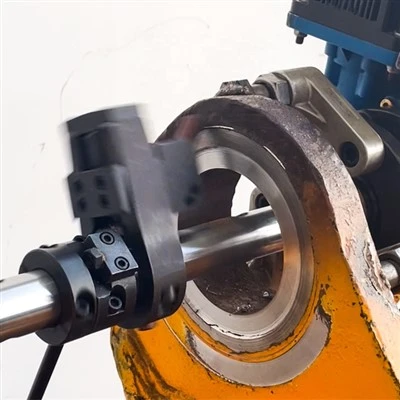
Let’s talk about how line boring works, just so you know it’s not some voodoo magic. We bring a portable boring machine right to your jobsite (no need to haul your huge excavator to a shop, which saves you on transport costs and downtime). We align the machine’s tool exactly with the old bore, spin it to cut a perfectly round, straight hole, then we install a new pin that fits snugly. The whole process is fast—for a mid-size excavator’s main linkage, it’s usually 4-6 hours, depending on how much wear there is. No need to take the whole machine apart, no shipping parts, just us and your machine on site.
Wait, what about if your excavator has a warranty? Should line boring void that? No, not if you do it right. In fact, a lot of warranty manuals say you’re required to do routine maintenance to keep the warranty valid, and line boring is part of that. If your machine’s manual says to inspect linkage bores and maintain alignment, then line boring is just proper maintenance, not a modification. I always tell customers to keep receipts for the line boring job, just in case they ever need to use the warranty—shows you kept up with required maintenance.
Let’s wrap this up with a quick checklist so you don’t have to Google it later:
- Do you have more than 1/8-inch of play in your linkage pins? If yes, line boring is likely needed.
- Is your digging inconsistent, or does the machine creak/lurch when swinging? If yes, check your bores.
- Do you use your excavator for heavy-duty work (demolition, rock digging, etc.)? Schedule a bore check every 100 hours.
- Have you already replaced pins that keep wearing out? Time to get the bores fixed with line boring.
I know you’ve got a million things on your plate as an excavator owner—jobs to run, parts to order, maintenance to remember. Line boring isn’t the funniest part of owning a machine, but it’s one of the smartest investments you can make to avoid costly downtime and big repairs down the line.
If you’re not sure if your excavator needs line boring, just reach out. I’ll come out, take a quick look, measure the bores and the play, and tell you exactly what you need—no hard sell, no hidden fees. No one wants to waste money on a job you don’t need, and no one wants to deal with a broken excavator on a jobsite. Let’s get your machine running smooth so you can get back to work.
Boring Welding Now, for the references:
- Caterpillar. (2021). Excavator Linkage Maintenance Guidelines. Caterpillar Equipment Services.
- Komatsu. (2022). Heavy Equipment Line Boring and Structural Repair Best Practices. Komatsu Construction Maintenance Manual.
- National Institute for Occupational Safety and Health (NIOSH). (2020). Construction Equipment Component Wear and Failure Analysis. U.S. Department of Health and Human Services.
- Association of Equipment Manufacturers (AEM). (2021). Routine Maintenance Protocols for Heavy Construction Machinery. AEM Technical Report Series.
Shangqiu JDA Machinery Technology Co., Ltd.
As one of the most professional line boring manufacturers and suppliers in China, our products have good reputation in the market. Please rest assured to buy cheap line boring for sale here from our factory. Quality products and reasonable price are available.
Address: No.55 Pingyuan Middle Road, Liangyuan District, Shangqiu, Henan, China
E-mail: sales@jdamachines.com
WebSite: https://www.jda-machines.com/
