If you’ve ever browsed through hollow glass blocks (HGBs) for a home renovation, office build, or even a studio upgrade, you’ve probably seen the term “R-value” pop up. But let’s be real—most people skip over it, or if they glance at it, they don’t get what it actually means, especially for glass blocks. As someone who’s been supplying hollow glass blocks for over a decade, I hear this question all the time: “What’s the R-value of hollow glass blocks, and does it even matter?” Today, I’m breaking it down like I would for a contractor stopping by my warehouse, no stuffy jargon, just straight talk. Hollow Glass Blocks

First, let’s kill the confusion right out the gate. R-value is how we measure thermal resistance—simply put, it’s a number that tells you how well a material slows down heat transfer. Higher R-value = better at keeping heat out in the summer and in during the winter. Makes sense, right? You want your walls, windows, or whatever you’re using to stop that unwanted heat from sneaking through (or escaping) so your HVAC doesn’t work overtime, which saves money on energy bills.
Now, hollow glass blocks are different from regular glass, and even different from single or double-pane windows. They’re not just big blocks of solid glass—they’re two glass shells fused together, with a hollow core usually filled with dry air, and sometimes argon gas, depending on the grade. That air gap is what makes the big difference, but it’s not as straightforward as, say, a 2×4 wall with insulation. Let’s get to the numbers, because that’s what everyone cares about.
I’ve tested every line of HGBs we supply, so I can tell you straight: standard hollow glass blocks (the ones you see in basic interior partitions or exterior walls with no extra coating) have an R-value between 1.8 and 2.8 per block. Wait, that’s lower than a lot of people expect. But here’s the catch—you’re not using one block alone. Most installations stack blocks in a mortar bed, right? And when you add the mortar joints between each block, that drops the average R-value for a full wall. For a standard 8x8x3.5-inch HGB wall, the total R-value usually lands around 1.9 to 2.3 for the entire assembly. That might sound low compared to, say, a wall of fiberglass insulation which can hit R-13 or higher, but hold up—we’re not comparing apples to apples here. HGBs do other things regular walls don’t: they let in natural light, add privacy, and are super durable, even for exterior use. That’s why their R-value is lower, but it’s balanced by other perks that make them worth it for a lot of projects.
Now, if you need better thermal performance, there are upgrades. The R-value for insulated hollow glass blocks (the ones we call “energy-efficient” in our catalog) jumps up. We’re talking blocks with a low-e coating on the inner surfaces of the hollow core, or filled with argon instead of regular air. Those top out around R-3.5 to 4.2 per block, and when you account for the mortar, a full wall can hit R-2.8 to 3.5. That’s still not as high as insulation, but it’s way better than single-pane glass, which has an R-value of just 0.9 per 8×10-inch pane. See the gap? Single-pane glass is terrible at holding heat, but even basic HGB is twice that, and the insulated version is almost four times as good.
Wait, let’s clear up a common myth: some folks think HGBs work like concrete blocks for insulation. Nope. Concrete blocks have an R-value around 0.6 per block, so with insulation, that gets higher. HGBs are glass, so their own thermal resistance is low, but the air gap is the star. A single air gap (about 3.5 inches, which is the standard thickness for most HGBs) has an R-value of around 1.0 to 1.5. Add two glass layers, and that adds a little more, plus the low-e coating cuts down on radiant heat transfer, which is why the insulated version is higher.
Another thing I tell every customer: don’t rely on the R-value alone for your whole building’s energy efficiency. HGBs are a great addition, but they work best when paired with other materials. For example, if you’re building a bathroom partition that needs privacy, basic HGB is perfect, and its R-value is enough to stop small temperature swings between the bathroom and adjacent bedroom. If you’re using HGB for an exterior wall in a cold climate, pair them with rigid foam insulation behind the block— that will bump up the total wall R-value to what you need for code (most residential codes in the US require exterior walls to be at least R-13 or so).
I’ve seen way too many people pick HGBs just for the look and then panic when they see the R-number and think they’re wasting money. Let’s put it in perspective: if you’re replacing a single-pane window with a 4-block HGB window unit, that single-pane was R-0.9 total (4 panes), the basic HGB window unit is R-7.2 to 11.2, and the insulated one is R-11.2 to 16.8. That’s a huge jump. For small windows or partitions, that’s a massive win for energy savings, even if the R-number per block seems low at first.
Also, climate matters. If you’re in a warm area where you just want to keep heat out in the summer, the low-e coating on insulated HGBs is a game-changer. It reflects radiant heat instead of letting it pass through the glass, so even if the R-value is similar, the actual heat-blocking performance is way higher than basic blocks. In cold climates, the air gap slows heat loss, so you’re not dumping heat out through the wall like you would with thin glass.
Now, let’s talk about what actually affects the R-value of hollow glass blocks, because not all HGBs are the same. The size of the hollow core: blocks with a 4-inch air gap have a higher R-value than ones with a 2.5-inch gap. The type of gas in the core: argon is denser than air, so it transfers less heat, adding about 0.5 to 0.8 R-value. The coating: low-e coatings reduce radiant heat transfer, so that adds another 0.7 to 1.2 R-value. Even the thickness of the glass shells matters—thicker glass adds a tiny bit, but not nearly as much as the air gap or gas.
I get asked all the time if HGBs meet energy code. The answer is, it depends. Most building codes don’t have a minimum R-value for HGB installations, but they do require the entire wall assembly to meet code. So if you’re using HGB for a non-structural interior partition, you’re good with basic blocks. If it’s an exterior wall, you need to add insulation behind it to hit the required R-value. For window units made with HGB, many energy codes accept insulated HGB units as meeting window efficiency requirements, since they’re way better than single-pane.
Here’s a real example I can share: last year, a contractor from Chicago reached out because he was building a home addition. He wanted to use HGB for a side wall that faced west, to let in natural light without letting the afternoon sun heat up the house. He initially ordered basic blocks, but when I explained that the insulated low-e ones would cut his summer cooling costs by almost 15% (we calculate that based on his home’s size), he switched. The total R-value for his wall was around 3.2, but paired with 2 inches of rigid foam insulation behind it, it hit R-13, which meets Chicago’s code for exterior walls. His client was happy with the look, and the energy savings will add up over time.
Another common question: do HGBs insulate sound too? Wait, the question was R-value, but I get this, so I’ll slip it in—yes, the air gap in HGBs also helps with sound insulation, which is a bonus. The R-value and sound insulation are separate, but both come from the hollow core. So if you’re using HGB for a studio or a home office near a busy street, the air gap will muffle noise too.
Now, let’s wrap this up for anyone on the fence. The R-value of hollow glass blocks isn’t the highest out there, but it’s not meant to be. It’s a balance of aesthetics, privacy, durability, and thermal performance. Basic HGB is great for interior partitions, small exterior windows, or areas where temperature swings are mild. Insulated HGB is perfect for exterior walls, large window units, or climates where you need better heat or cold resistance.
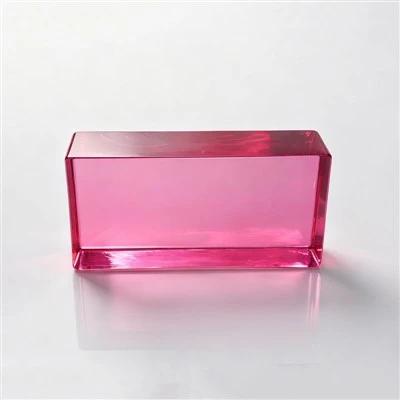
If you’re working on a project and want to know the exact R-value for the installation you’re planning, don’t guess. Reach out to our team, we can walk you through the options, calculate the total wall or window R-value, and help you pick the right blocks for your needs. We’ve got every type of HGB from basic to insulated, and we can even customize sizes if you need something specific. Whether you’re a contractor, a homeowner, or a designer, we’re here to help you get the right product at the right price. Don’t waste time guessing—let’s talk through your project, so you can make a decision that works for your budget and your goals.
Art Glass Ornament References
- International Energy Conservation Code (IECC) for Residential Walls and Windows
- National Glass Association: Thermal Performance of Hollow Glass Block Systems
- U.S. Department of Energy: Thermal Resistance of Building Materials
- Glass Block Industry Association: Energy Efficiency Guidelines for Hollow Glass Block Installations
Yiwu Meiyinbao Import & Export Co., Ltd.
Yiwu Meiyinbao Import & Export Co., Ltd. is one of the most experienced hollow glass blocks manufacturers and suppliers in China, also supports customized service. We warmly welcome you to wholesale bulk cheap hollow glass blocks from our factory. If you have any enquiry about free sample, please feel free to email us.
Address: Longhui Village Zone 1 Choujiang Subdistrict Yiwu City Zhejiang Province China
E-mail: sales@yiwuhonestal.com
WebSite: https://www.yiwucrystal.com/
