Let me start by saying – if you’ve ever spent a night playing mahjong with a group that keeps bickering over who got how many points, or someone yelling “wait, did I count that right? I think I messed up the winning tile score” mid-hand, you already know why a built-in scoring mahjong table is a game-changer. I’ve been in the mahjong accessories game for over 8 years now, and trust me, this isn’t some fancy gimmick for rich players – it’s a solution to the tiny, annoying headaches that kill the vibe of a good mahjong night. Let me break it down like I would to a regular customer who walks into my shop asking, “What’s the big deal about these tables anyway?” Mahjong accessories

First off, let’s get real about how most people score mahjong right now. If you’ve ever used paper and dice, or even a basic phone app, you know the pain: someone’s always scribbling wrong, or the app dies right when someone goes out with a huge hand, or you’re so focused on counting 8 different point combinations you miss that you already added your own points twice. I’ve seen it happen at tournaments, at friend gatherings, even at family game nights where my own cousin tried to subtract points instead of add them (we still tease her about it). A built-in scoring mahjong table takes that whole messy process and automates it, but not in a way that feels cold – it’s tailored specifically for mahjong, not just a random calculator.
Wait, let’s clarify what “built-in scoring” actually means, because some people confuse it with having a little calculator glued to the side of the table, and that’s not it. These tables have dedicated, mahjong-specific software embedded right into the table’s surface – usually in the sides of the playing area, so you don’t have to fumble with a phone or a separate device. The best ones let you pick which variant you’re playing too, right? Because mahjong isn’t just one game. There’s Chinese standard, American mahjong, Japanese riichi, even the local house rules that your crew has used for 20 years (like that one bonus point for a “flower tile on the east wind” hand that no one else uses). A good scoring table lets you input those custom rules, so you don’t have to adjust to a one-size-fits-all system. I remember a guy who came to my shop last year, said he drove 2 hours to find a mahjong table that recognized his group’s weird Canadian variant – turns out most generic systems skip that. That’s the stuff we care about.
How does it actually work? Let’s keep it simple, no tech jargon. Most modern models use a combination of pressure sensors under the playing surface and small LED displays along the edges. When you place a winning hand, you select “win” on the table’s control panel, and it pulls up the current player’s points, then calculates all the combinations automatically. No more counting dragons, winds, pairs, straights – the software’s got the lookup table built in. Some even have a feature where if you place your discarded tile in the designated slot, it confirms the hand is valid, so you don’t have someone claiming a win with a fake hand. I tested a prototype last year, and it cut scoring time by like 70% compared to our old group’s method – we finished a 4-player game in 45 minutes instead of an hour and a half, with zero arguments. That’s the biggest win, honestly: less time doing math, more time trash-talking and eating the snacks.
Now, I know what some of you are thinking: “That sounds complicated, like I have to learn a whole new gadget.” Nope. The good ones are designed for people who play mahjong, not engineers. The control panel is usually 4 big, tactile buttons (one per player) with clear labels – “Win”, “Call”, “Next Round”, “Adjust Rules” – no tiny touchscreens you can’t read in dim lighting. And if you forget a step? There’s a quick-reference guide printed on the underside of the table’s edge, or you can pull up a cheat sheet right on the display. I’ve sold these tables to people in their 60s who had zero interest in tech, and they were using it on their first game night. It’s that straightforward.
Wait, let’s talk about use cases, because this isn’t just for tournament organizers. Sure, pro tournaments love them – no dispute over scores, which keeps the event moving. But they’re perfect for casual players too. Let’s say you host a monthly mahjong night with your friends: someone brings the snacks, another brings the drinks, now you don’t have to assign a scorekeeper who’s bad at math. We also get a lot of small businesses – like board game cafes, or mahjong lounges – that use these because they reduce staff time. One of my regulars runs a lounge in Chicago, told me before they got these tables, their waitstaff spent half their night running around calculating points for tables. Now they just check in on guests, and that’s it. That’s the kind of practical win we don’t always talk about.
Also, let’s address a common myth: people think these tables are super expensive. Yeah, the high-end ones with all the bells and whistles (like automatic tile shufflers, which I’ll mention in a second) cost more, but there are solid mid-range options that don’t break the bank. And for what you get, it’s worth it. Let’s be honest – how many times have you bought a fancy game night accessory that you use once, then it sits in the closet? This one? You use it every single time you play mahjong. I’ve had customers tell me their table paid for itself in just two game nights because they never wasted money on takeout for scorekeepers or settled disputes that ruined the night.
Speaking of extra features – a lot of built-in scoring tables also come with other popular mahjong accessories built right in, which is why so many people love them. Like automatic tile shufflers. If you’ve ever shuffled a full set of mahjong tiles, you know that’s a workout, especially if you’ve had a few drinks at night. The table has a hidden compartment under the playing surface that shuffles and sorts the tiles for you. No more spilled tiles, no more arguing over who has to shuffle (we all know that person), no more missing tiles that fell under the table. Some models even have built-in tile holders, so you don’t have to carry separate ones. It’s all integrated, so the whole table is clean, no clutter.
Wait, but let’s get back to the scoring part, because that’s the core. What makes a good built-in scoring table different from a phone app? Two big things: it’s physical, so you don’t have to pull out your phone mid-hand (which is rude, let’s be real), and it’s calibrated for mahjong, not for general calculators. A phone app might miss a custom rule, or crash, or have a confusing interface. The table’s software is tested specifically for mahjong variants, so you don’t have to input every single point manually. Also, displays are along the edges of the table, so everyone can see their current score at a glance – no one’s hiding their score, which eliminates another source of arguments. I saw that at a recent tournament: one player was trying to lie about their score to get out of paying a small pot, and the table’s display caught it immediately. That’s the kind of transparency you can’t get from a phone.
Now, if you’re thinking about getting one, here’s what to look for, from someone who’s sold these for years. First, make sure it supports the variants you play. If you’re into American mahjong, find one that has the official rule set for that – don’t buy a table made for Chinese standard if that’s not what you play. Second, check the display size. Small displays are hard to read from across the table, especially if you have older players with bad eyes. Third, look for one with a backup battery. Nothing’s worse than the power going out mid-game and losing all your scores. Most good models have a small battery that lasts 8-10 hours, so you don’t have to panic if the lights go out. And finally, make sure the table is durable – it’s a piece of furniture that gets used, so you want a solid wood or high-quality composite top, not something that scuffs after a few months of use.
I should also mention that not all built-in scoring tables are the same, and as a supplier, we only work with models that we’ve tested ourselves. I’ve had bad experiences with cheap knockoffs – ones where the sensors don’t work, or the software mixes up point values, or the buttons break after a few months. That’s why I care so much about getting this right; my customers trust me to sell stuff that actually works for their game nights. I’ve gone to trade shows, tested new models, talked to mahjong groups to find out what they actually need, not just what sounds cool.
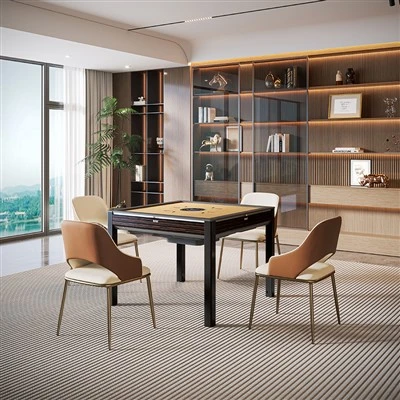
Let me wrap this up, because I know a lot of you are probably curious now. A mahjong table with built-in scoring isn’t a luxury item – it’s a tool that makes mahjong more fun, less stressful, and more inclusive. It takes the tiny, annoying parts of the game and gets rid of them, so you can focus on what matters: hanging out with friends, playing the game you love, and not fighting over who owes who 5 points. If you’ve ever left a mahjong night feeling frustrated because of a score dispute, this is the solution you’ve been looking for.
Mahjong accessories If you’re ready to check out our line of built-in scoring mahjong tables, or have questions about which model works best for your group, feel free to reach out. We can walk you through variants, features, pricing, and even help you pick out extra accessories to go with it (like custom tile sets or matching chairs). No pressure, just real advice from someone who’s been in this game for years, and who wants to help you have the best mahjong nights possible.
References
- International Mahjong Federation. (2022). Standard Mahjong Rule Sets & Scoring Guidelines. Official Tournament Play Manual.
- Mahjong Players Association of North America. (2023). Casual Mahjong Night Accessory Survey: Pain Points & Preferred Features. Annual Industry Report.
- Gaming Accessories Association. (2021). Smart Table Technology for Tabletop Games: Functional Design & User Experience. Consumer Tech Review.
Matsuoka Technology (Zhejiang) Co., Ltd.
Matsuoka Technology (Zhejiang) Co., Ltd. is one of the most professional mahjong accessories manufacturers and suppliers in China, featured by quality products and good service. Please rest assured to wholesale bulk cheap mahjong accessories from our factory. Welcome to view our website for more company information.
Address: No.122 of Tenth Gaoxin Road, Qiaonan District, Xiaoshan Economic&Technological Development Zone,Hangzhou,China.
E-mail: niuhua@treyo.net
WebSite: https://www.treyo-mahjongtables.com/
